Generative research on account configuration
company

team
UX Researcher (me)
Sr. UX Researcher as an advisor
3 Product Managers
2 UX Designers
Timeline
5 weeks, 2025
Project Overview
I conducted a generative study with small and medium business (SMB) and enterprise admins to understand persistent account configuration challenges, identifying critical discovery gaps and configuration barriers. My findings secured additional funding, elevated guided onboarding as a strategic priority, and shaped the product roadmap for account configuration improvements.
Amazon Business allows companies to organize employees into multiple hierarchical layers with different controls applied at each level. However, this flexibility in managing a large number of users came at a cost. The ‘group’ features generated the most customer support tickets in the Account Management category for two consecutive years. Furthermore, confusion about group features was often the underlying cause of issues in other categories, such as budget management and multi-legal entities.
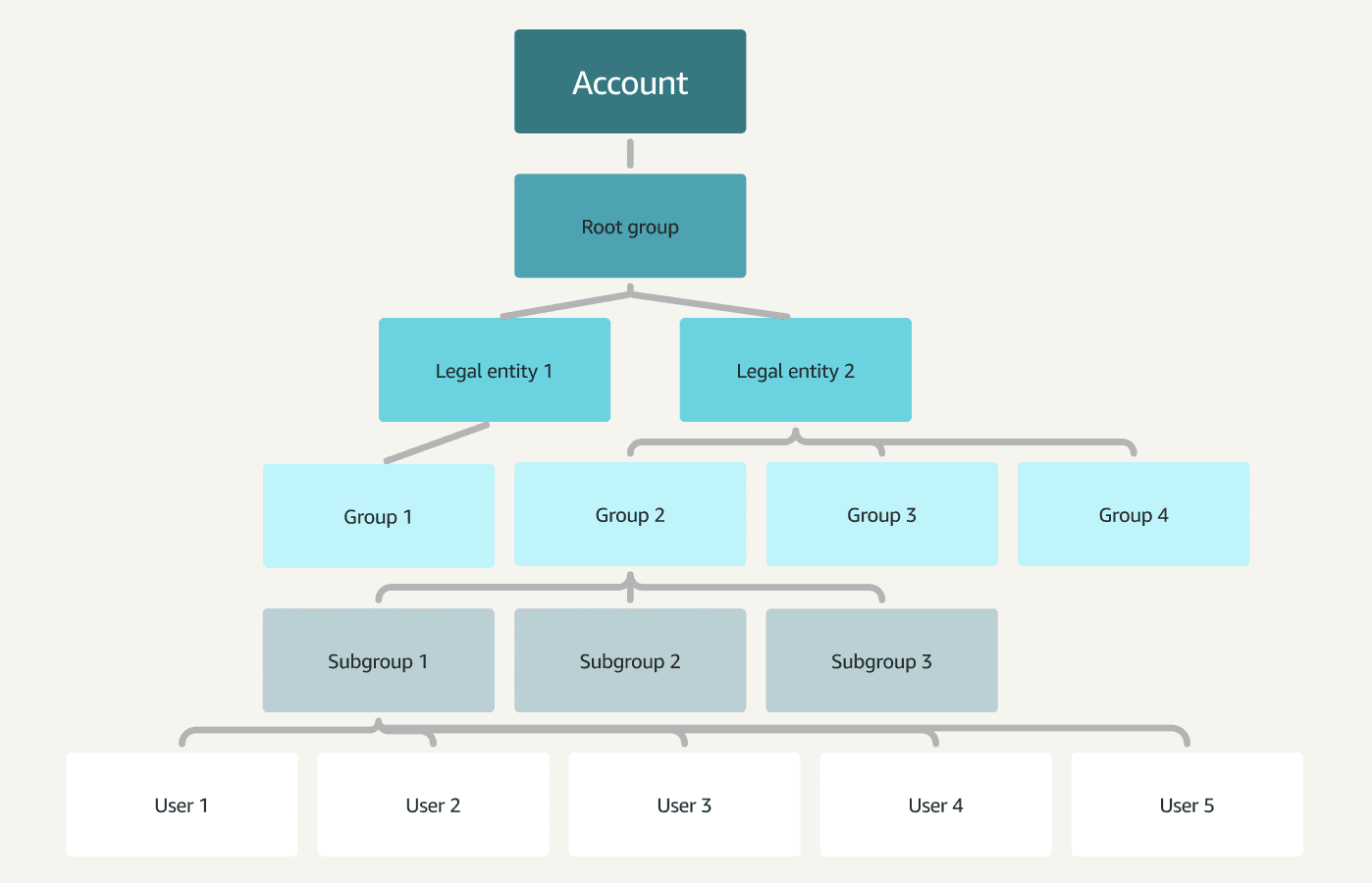
Above: Different group levels allow admins to apply different settings to users within each group.
Research Goals
In order to simplify managing an Amazon Business account with groups, I aimed to:
Understand reasons and contexts behind using group features
Inform project prioritization and provide direction for addressing account configuration problems
Research Questions
1. When and why do admins create groups?
2. Why do admins use particular group configuration features?
3. What limitations do admins face in account configuration, and how do they work around them?
4. What support do admins need when setting up accounts?
Procedure
Methods
Product usage analysis
I analyzed feature usage data on the account configuration page to identify signs of pain points and workarounds. I compared how often users edited groups directly versus using Excel import and export, and examined action sequences within sessions.
9 semi-structured interviews with contextual inquiry
After asking about participants' motivations and limitations with the group feature, I asked them to walk through their typical account management tasks while sharing the screen. This allowed me to observe behaviors they might not have recalled and gain a more concrete understanding of their challenges and contexts.
Participants (n=9)
4 admins managing small and medium business accounts
5 admins managing enterprise accounts
Challenges
Navigating Stakeholder Disagreement on Participant Recruitment
Challenge
With 3 PMs, 2 designers, and 2 researchers involved, the team was divided on recruitment strategy. Most stakeholders wanted to focus on small and medium businesses (SMBs) who lacked dedicated account managers and could benefit from better awareness of features. One stakeholder advocated for enterprise users, citing complaints about limited access to account managers.
Strategy
I determined that both perspectives were valid. Rather than advocating for one approach and risking prolonged debate, I proposed a lean, data-driven strategy: start by testing with a small number of SMB users, then compare findings with a smaller number of enterprise users, and let the data guide recruitment focus. Because SMB users could be recruited quickly and represent a large portion of Amazon Business users, I recommended starting there.
outcome
Enterprise users provided significantly richer insights into account configuration challenges and unmet needs, compared to SMB users who barely used the group feature. Based on these findings, I proposed shifting recruitment to focus on enterprise users, and all stakeholders aligned immediately.
This iterative, evidence-driven approach helped the team to focus on the right target users and uncover critical insights that informed product prioritization.
Results & Impact
Key Findings
Findings below have been revised to comply with NDA requirements.
Finding 1: Critical Features Remain Undiscovered
More than half of admin participants were unaware that features they considered essential, such as setting budget limits and restricting purchase categories by group, already existed in Amazon Business. This gap was more pronounced among SMB admins than enterprise admins. Given that SMBs represent the majority of Amazon Business customers, addressing this discovery issue could significantly improve platform value for most users.
Finding 2: Enterprise Admins Struggle with Account Configuration Complexity
Enterprise admins faced significant barriers when configuring accounts for their organizational needs, prolonging setup time and requiring additional support. Key challenges include:
Unclear feature scope: After discovering groups and buying policies, admins couldn't determine the capabilities and limitations of each feature.
Configuration uncertainty: Admins were uncertain which configuration approach fit their organizational structure.
Costly errors: Configuration mistakes were difficult or impossible to undo without contacting support.
Impact
This research directly influenced funding, prioritization, and product strategy:
Secured additional funding: Findings provided evidence for a budget increase request
Prioritized guided onboarding: Elevated the recommended project as a priority to address the discovery gap affecting the majority of customers
Informed product roadmap: Shaped future account configuration improvements, including exploration of AI-powered tools and account structure templates
Validated ongoing initiatives: Strengthened stakeholder confidence in current direction and investment decisions