Generative research to uncover what students and bootcampers need
company

My Role
Lead UX Researcher
Team Facilitator
Team
3 UX Designers
Co-founder & CEO
Timeline
10 weeks, 2024
Project Overview

Impact
By challenging the company's unvalidated assumptions, I identified a new customer group whose needs closely overlapped with students', letting the company expand its reach through marketing alone rather than building separate features.
The company shipped the redesigned beta app within 12 months of the research findings, based on the direction my team and I recommended for serving the new target audience.
My Approach
The Learners' CEO presented the following assumption to my team:

My team initially agreed that students were a strong target audience, since valuable resources tend to spread quickly among peers with similar career interests.
However, I challenged the assumption that students had the greatest need, since they already have access to school-based resources like professors and alumni. I proposed testing another hypothesis: that UX bootcamp participants, who are transitioning into UX but can't fully commit to formal education, have an equally strong need for a resource like Learners.
I recommended including bootcampers in the study because they:
Represent a large, well-networked group at a similar career stage to students
Could expand the user base with minimal additional effort, if their needs aligned with students'
The CEO and team agreed, and we added bootcampers to the research scope.
Research Questions
How might we effectively support students and bootcamp participants who aspire to work in the UX industry?
To answer the main question, we prioritized addressing the following sub-questions:
What are the learning needs and interests of students and bootcamp participants?
What features will motivate them to download the app?
How are they currently learning to grow as a UX professional?
My Role
Lead UX Researcher
As the team's most experienced researcher, I led:
- Research plan development and bootcamp participant recruiting
- 8 of the 11 moderated interviews
- Survey design and user journey mapping
- Coaching teammates through their first interviews
- Synthesis of findings and the final presentation
Team facilitator
- Prepared meeting agendas
- Moderated weekly meetings with Learners' CEO and our mentor
- Took notes for the team
Procedure
Weekly CEO Interviews
Proposed weekly check-ins to get first-hand insight into company priorities and prior research
Competitive Analysis
Identified Learners' strengths/weaknesses vs. competitors UX students use
Found services target users want but competitors don't offer
11 Moderated User Interviews
6 students (HCI/HCDE) to understand needs and the reasoning behind them
4 bootcamp participants, recruited via UX networking events
1 UX professional (portfolio reviewer) to validate findings via a third party
Survey: 151 Entries
Quantified interview insights and validated findings across students and bootcampers
Deliverables
Competitive Analysis
Survey Analysis
User Journey Maps
Application Preview
Results
The company's model runs on free, scalable services, so leadership's core success metric is engagement: how often and how long people use the product. That framing shaped which problems we prioritized and which recommendations we pursued.

Survey of UX students and bootcamp participants on the biggest challenges they faced pursuing a UX career.
Insight 1: The company's strongest asset, its network of UX professionals, is underused because students are hesitant to reach out and professionals have little reason to respond.
Evidence
Competitive analysis showed the UX professional network is the company's clearest differentiator. But interviews with students surfaced two blockers: they fear burdening strangers or being judged, and they're unsure what's appropriate to ask. On the other side, professionals said they get the same handful of questions repeatedly, with little incentive to keep answering.
Recommendations
Show mentor availability so students know who's actually open to being contacted, and display in-app tips on how to approach a professional.
Make past questions searchable by topic and career level so students can self-serve before cold-messaging.
Recommend mentors by shared background to give professionals a more personal reason to respond.

In the previous app, users couldn't search for specific questions and had to scroll through the list to find what they wanted.
Insight 2: Students want to apply portfolio advice to their own case, but the feedback in the app is generic, one-off, and inconsistent between mentors.
Evidence
Current resources offer general tips for common problems rather than a review of a specific portfolio, and one-on-one reviews are rare. When students did get feedback, mentors in different roles judged by different standards, often not the standards for the career the student was actually aiming at. This gap also connects to the company's weakness with the student audience: low brand recognition and content that isn't built for quick, mobile consumption.
Recommendations
Enable students to submit portfolios for mentor review, and make those reviews visible to other students as worked examples.
Let users vote on the most helpful critiques so beginners can see what strong feedback looks like.
Match mentors to reviewers whose role and field align with the student's own career goals.
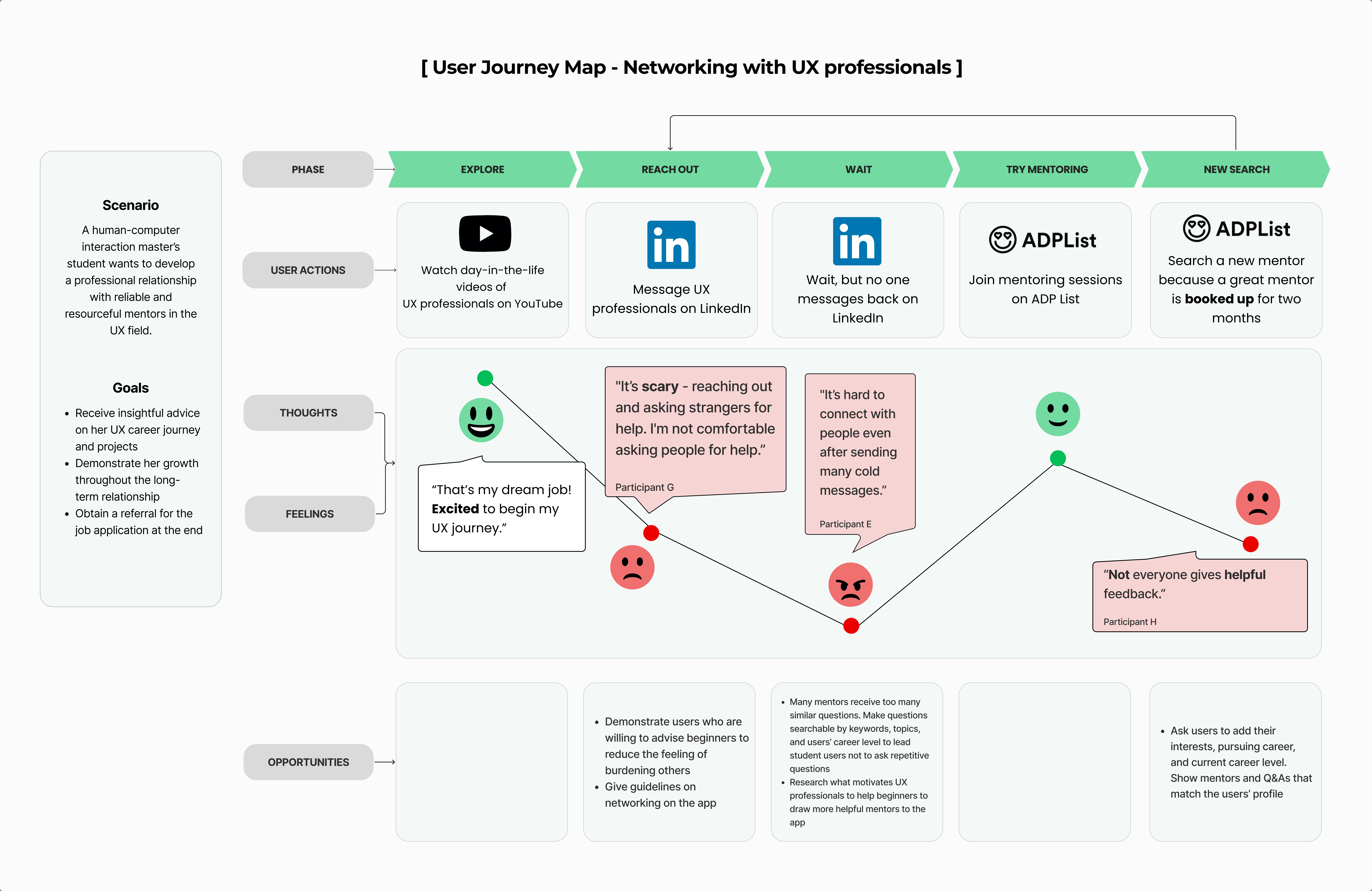

The insights have guided the direction for the mobile application redesign, highlighting specific features to target in the coming years.
After the final presentation, the CEO mentioned that offering public portfolio reviews was a scalable feature his team hadn’t expected students to want, but they would like to prioritize it in the new app.
I identified a new group of target users—bootcamp participants—with similar needs, enabling the company to expand its potential user base with minimal cost and effort.
Plan ahead to prevent AI from manipulating survey results
Offering a monetary incentive and posting the survey publicly on LinkedIn attracted hundreds of AI bot responses from fake accounts. I addressed this by adding reCAPTCHA and validation questions, randomizing the question order, and manually removing the bot responses. Next time, I'll build these safeguards in from the start rather than reacting after the fact.
Become a domain expert to give recommendations that stakeholders find helpful
Our secondary research didn't go deep enough into the EdTech domain from the perspective of a stakeholder who is an expert in the field. A stronger grasp of the industry would have produced more valuable insights and built more trust with stakeholders. Moving forward, I'll prioritize becoming a domain expert early in the process.